Someone from the SF Bee Club posted this link from the USDA Agricultural Research Service on our bee list for a wallet ID card for the native bees in Utah. I LOVE it that there are people out there that care enough to make a wallet ID card...and who believe enough that there are others who care that might want this thing in their wallet. I know I do!
How To: Identification Bumble Bees of
written by
illustrations by Linda Kervin
The
Bumble bees possess three attributes that will help you to distinguish them from all other bees in the region: they are big, they are more furry than most other bees, and females transport pollen as a wet mass held in a “pollen basket” on the hind leg. The pollen basket of the hind pair of legs is broadened and concave like a shallow, elongate spoon. If empty, its polished surface can be seen reflecting light. Only the honey bee in our fauna has a similar pollen basket; all other bees here that collect pollen carry it in a dense brush of hairs either on the hind leg or under the abdomen. Bumble bees are much more furry than the honey bee, the only other bee here that has a pollen basket.
| |
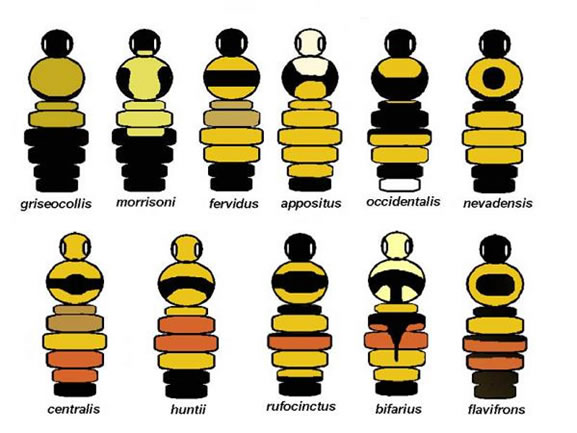

We have depicted the eleven bumble bee species of
Some of the species will be exceedingly difficult to distinguish in the field, especially worn individuals, but other species can be recognized given a trained eye. There are three attributes of a bumble bee’s furry coat that you should see and note for identification. Progressing from head to abdomen, these are:
| | 1) Head. What is the hair color atop the head yellow or black? 2) Thorax. Is there a patch of black hair on the top of the thorax, between or behind the wings? If so, is it a disc of black, a band of black, or is the entire hind half of the thorax covered in black hair? 3) Abdomen. Is the tip white? Are there orange bands? Which segments are orange? Is an orange band split by a central black stripe along the upper surface? Are the yellow hairs greenish or golden? |

This might seem like a lot of detail to gather from such a small creature, but with a bit of practice it becomes easy and quick to see and note these features, just as when you are trying to identify a bird. To make it a bit easier, carry a notebook in which you can jot down the information or sketch the bees that you see. Binoculars can help with bees on bushes or in more inaccessible places. Importantly, take the time to enjoy watching the bee as she forages, and listen for her buzzing those flowering species that shed their pollen like a salt shaker through tiny pores at the tips of the anthers (examples include shooting star, tomato, and nightshade).
If that was not enough. How about this extensive chart from bumblebee.org
Bombus fraternus  Range: New Jersey down to Florida, North and South Dakota, Nebraska, Colorado and New Mexico. | Bombus crotchii   Range: California and Mexico | Bombus nevadaensis auricomus  Note: sometimes just called Bombus auricomus. Range: Ontario to Florida, west to Texas, Oklahoma, Colorado, Wyoming, Montana, Saskatchewan, Alberta, British Columbia. |
Bombus nevadensis nevadensis  Range: Alaska to California, Arizona, New Mexico east to Wisconsin, Mexico. | Bombus morrisoni  Range: British Columbia to California, east to South Dakota, Nebraska, Colorado, New Mexico. | Bombus pennsylvanicus pennsylvanicus Range: Quebec, Ontario south to Florida, west to Minnesota, S. Dakota, Nebraska, Colorado, New Mexico, Mexico.  |
Bombus pennsylvanicus sonorus  Note: sometimes known as Bombus sonorus Range: Texas, west to California, Mexico | Bombus grisecollis  Range: Quebec south to Florida, west to British Columbia, Washington, Oregon, northern California | Bombus perplexus  Range: Alaska to Maine, south to Wisconsin, Illinois, Florida, Alberta |
Bombus bimaculatus  Range: Ontario, Maine south to Florida, west to Illinois, Kansas, Oklahoma, Mississippi. | Bombus impatiens  Range: Ontario, Maine south to Florida, west to Michigan, Illinois, Kansas, Missouri. | Bombus affinus  Range: Quebec, Ontario south to Georgia, west to South Dakota and North Dakota. Note: Also known as the rusty-patched bumblebee. Range has declined sharply recently, now found in only a few areas. Often has a bald patch between the wings in the middle of the thorax. |
Bombus vagans vagans  Range: British Columbia east to Nova Scotia, south to Georgia, Tennessee, South Dakota, Montana, Idaho, Washington. | Bombus sandersoni   Range: Ontario to Newfoundland, south to Tennessee and North Carolina | Bombus frigidus  Range: Alaska and Northwest territories, south to Colorado (high elevations only). |
Bombus lucorum queen  Range: Alaska south to Southern British Columbia and Alberta, east through Yukon and North Western Territories. More>>> | Bombus lucorum worker  | Bombus lucorum male  |
Bombus ternarius  Range: Yukon east to Nova Scotia, south to Georgia, Michigan, Kansas, Montana, British Columbia. | Bombus terricola occidentalis  Range: Alaska south to northern California, Nevada, Arizona, New Mexico, South Dakota. Note: also known as Bombus occidentalis. | |
Bombus vandykei  Range: Washington to southern California | Bombus vosnesenskii  Range: British Columbia south to California, Nevada, Mexico | Bombus californicus  Range: British Colimbia, Alberta south to California, Arizona, New Mexico, Mexico |
Bombus rufocinctus  Range: Nova Scotia, New Brunswick, Quebac, west to British Columbia, south to California, Arizona, New Mexico, Kansas, Minnesota, Illinois, Michigan, New York, Vermont, Maine, Mexico. | Bombus rufocinctus  Range: Nova Scotia, New Brunswick, Quebac, west to British Columbia, south to California, Arizona, New Mexico, Kansas, Minnesota, Illinois, Michigan, New York, Vermont, Maine, Mexico. | Bombus rufocinctus  Range: Nova Scotia, New Brunswick, Quebac, west to British Columbia, south to California, Arizona, New Mexico, Kansas, Minnesota, Illinois, Michigan, New York, Vermont, Maine, Mexico. |
Bombus caliginosus  Range: Washington, Oregon, and coastal areas in California | Bombus bifarius nearticus  Range: Alaska to Yukon south to California and Utah. | Bombus bifarius bifarius  Range: British Columbia, Oregon, California, Idaho, Utah, Colorado. |
Bombus balteatus  Range: Arctic Alaska and Canada, Sierra Nevada and White Mountains, Truchas Peak in New Mexico. | Bombus hyperboreus  Range: Arctic Alaska, Yukon, Northwest Territories, Greenland. | Bombus polaris polaris  Range: Arctic Alaska, Canada, Greenland and Arctic Eurasia. |
 Range: Oregon, California, Nevada |  Range: Alaska south to northern California, Idaho, Colorado |  Range: Southern Canada from Nova Scotia to Alberta, Northern USA from Maine to New Jersey wast to North Dakota and South Dakota. |
 Range: Quebec and New Brunswick south to Georgia, west to British Columbia, Washington, Oregon, California and Mexico. |  Range: British Columbia east to Saskatchewan, south to New Mexico, Arizona and California. |  Range: Alaska east to Newfoundland, south through the mountains (Cascases, Sierra Nevada, Rockies), California, Utah, New Mexico. |

 | (C) Copyright 1997-2009 |


