Showing posts with label inspection. Show all posts
August 26, 2011
Dog Days
Our bees have not had a good season. The cold rainy winter lasted until the end of June and even a little into July. While it stopped raining, we did not see the sun until August. The bees were not flying, the flowers were not blooming, it was cold, windy and miserable. We found foulbrood, usually a winter disease, in one of the hives in June so we had to treat it with antibiotics and lose access to all the honey they produced. The swarm we caught near the school slowly dwindled away to nothing despite the fact they had a laying queen. The smaller secondary swarm from our main colony did not have a good queen or something tragic happened to her and we watched that colony develop a laying worker and become a colony of all drones.
We have a had a month of good weather so we thought for sure we would be harvesting some honey today. We had a look in the first hive, the swarm we caught at the school. The bees clustered on one frame and were just about the size of a tennis ball. No queen. This hive will be dead in a week.
The second hive had a good pattern of brood and I could not see or smell any signs of foulbrood. But there was only enough honey for the hive, not enough for us to take any. I was grateful they were doing well and did not care if we got honey from them or not.
The third hive was the small swarm from out main hive. Cluster of bees about the size of a tennis ball, like the first, no queen. Doomed.
The fourth hive was doing great. Three boxes full of healthy activity, though they were using only 2/3 of the boxes and gathering mainly on the east side, leaving two or three frames empty on the west side, probably because of the way the sun hit the hive. We took the top box off and looked into the second box. That's when I smelled it. Foulbrood. Damn it. We tried to figure out how to deal with it without throwing away more equipment. No way around it. We had to make a new box for them, dump them in, treat them with antibiotics and throw away all their hard work.
After that disappointment I was excited to see if the fifth colony, the big one where the queen got stuck in the honey supers, had recovered. We had seen larvae in the lower boxes before I left town for a few weeks but we were uncertain if it was going to be new worker bees from the recently freed queen or drones from the laying worker. I had noticed a few days ago that very few bees were flying in and out of the hive. As we opened it up it became clear why. The colony was completely gone. The only bees in the boxes were robber bees from other colonies. There were two frames of spotty dead capped worker brood (not drone, so yay!) and some had even tried to chew their way out before they died. But whjere the heck did the queen and all the workers go? It seems like they absconded rather than died out or swarmed, though I suppose there could have been zero nurse bees to keep the eggs and larvae fed and warm. Or they died before the new ones could hatch. Not sure. Not experienced enough to know exactly what happened. All I know is they are gone and we have no honey.
Not the very best news. But at least we have two colonies that are doing OK. Not great, but OK.
This was one of the most disheartening days I've had as a beekeeper. I am afraid that the foulbrood spores have contaminated the entire area in the garden where we have the beehives and are probably also in all of our spare boxes and frames. Probably a thousand dollars' worth of hive boxes and frames possibly useless. Not possibly. Probably.
Peter and I discussed the possibility of buying a new colony and putting it on the roof in all new equipment to see if it did better up there in the full sun. I have always thought it was too shady and cold back there where they are now. I have been wanting to try a hive on the roof but am sad that we have to do it because our other hives are failing.
July 27, 2011
larvae spotted in Big Hive
Well, the good news is that we found larvae in the brood boxes of the Big Hive today. We are not sure if it is new larvae from the recently freed queen (the one trapped in the honey supers for who knows how long) or if it is drone larvae from the laying worker we kicked out. Once it is capped we will be able to tell since the drone larvae sticks out a lot more than the flat sandy colored capped worker brood.
July 10, 2011
Queen Trapped!
Today we went out to harvest the frames of honey off the Big Hive. When we opened up the top box and removed the inner cover at first we did not quite understand what we were looking at. The capped and partially capped frames of honey we put in there two weeks ago from the other hives were chewed open and empty. It looked like instead of finishing off the honey and capping it, they had instead decided to eat it all. But why?
I wanted to see what was happening in the brood boxes, even thought this colony is usually pretty aggressive, so we popped the three very light supers off and set them aside while we looked into the brood boxes. All we could see were capped drone cells and no worker cells at all. The population had really dropped dramatically since the last time we were in here. This hive was in big trouble. It seemed like it had somehow lost the queen and it looked like there were mainly drones populating the boxes. Signs of a laying worker. But what happened!!!!! There was a very good queen in there just a month before. We looked for succession or swarm cells and found none. The only thing to do was to get rid of the laying worker, put in a frame of eggs from another hive (if we could find one we could spare), and hope that they could raise a new queen for themselves.
Getting rid of a laying worker is a very time consuming and disruptive process. You can't tell which worker it is so you have to take the whole hive far away and dump all the bees out onto the ground. The theory being that the laying worker has never left the hive in her life and will not be able find her way back to fly back in. The field workers and drones will. Problem solved. And it makes the birds really happy because all of a sudden there is a huge pile of confused bees wandering around on the ground just waiting to be eaten.
We got ready to dump the workers out to get rid of the laying worker. That's when Charlie spotted a black queen running around in one of the honey supers we had just taken off a few minutes before. Somehow she got trapped up there. Probably our fault. The poor thing had no room to lay eggs because the supers were full of capped or partially finished honey and no attendants to clean out the cells for her. The colony probably could still smell she was in the hive so did not think to make a queen cell until it was too late. And then a worker started laying and they just make drones...who in turn are hungry little guys. The drones ate all the honey we had been counting on harvesting today.
This is all an educated guess. Not sure what actually happened, but who cares, we have a queen! Relieved, we set her aside in a closed box so she did not fly away and then reassembled the brood boxes after dumping all the workers and drones out across the yard.
A big set back but maybe this colony will bounce back.
Beekeeping seemed easier when we first started. The more I learn the harder it gets.
June 20, 2011
red and black queen


We figured if the sun stays out long enough today we will be pulling honey frames out of the beehives and harvesting it all weekend. We figured wrong.
No Honey. Bees are on strike. Each hive has its own issues and demands. None include giving us any extra honey. But we did find a red queen who is making blond and redheaded bees. And then a black queen who is laying dark black and gray bees. Wish I had the camera with me.
The Small Swarm and the School Yard Bees are not really thriving. We could not find a queen but it seemed like there was larvae. The populations seem to be dwindling. I did not smell or see foulbrood. Maybe the old queens are just not laying well and they will make a new queen.
The Split is doing OK after we treated them with antibiotics, but we would have liked to add a few frames of brood and nurse bees to boost the population to get them going. Unfortunately, none of the other colonies had anything to spare. We also realized that we should have pulled the capped honey frames out of the Split before we gave them antibiotics because now we cannot use it for human consumption.
Our Big Hive looked like it was doing great so we did not open up the brood boxes. They tend to be aggressive so we figured no need to bother them if they were doing OK. Their honey supers were close to being finished but not quite ready. We moved some of the capped and partially capped frames of honey from the smaller weaker hives into the Big Hive's supers so the Big Hive could finish them up quickly and we could harvest them maybe next week.Here's to the first (and late) harvest of 2011.
May 9, 2011
May 7, 2011
May Inspection
We took advantage of a nice sunny day to have a look at the new colonies and do a hive inspection in the apiary. The Small Swarm and the School Yard Bees seem to be doing well. Lot's of activity.
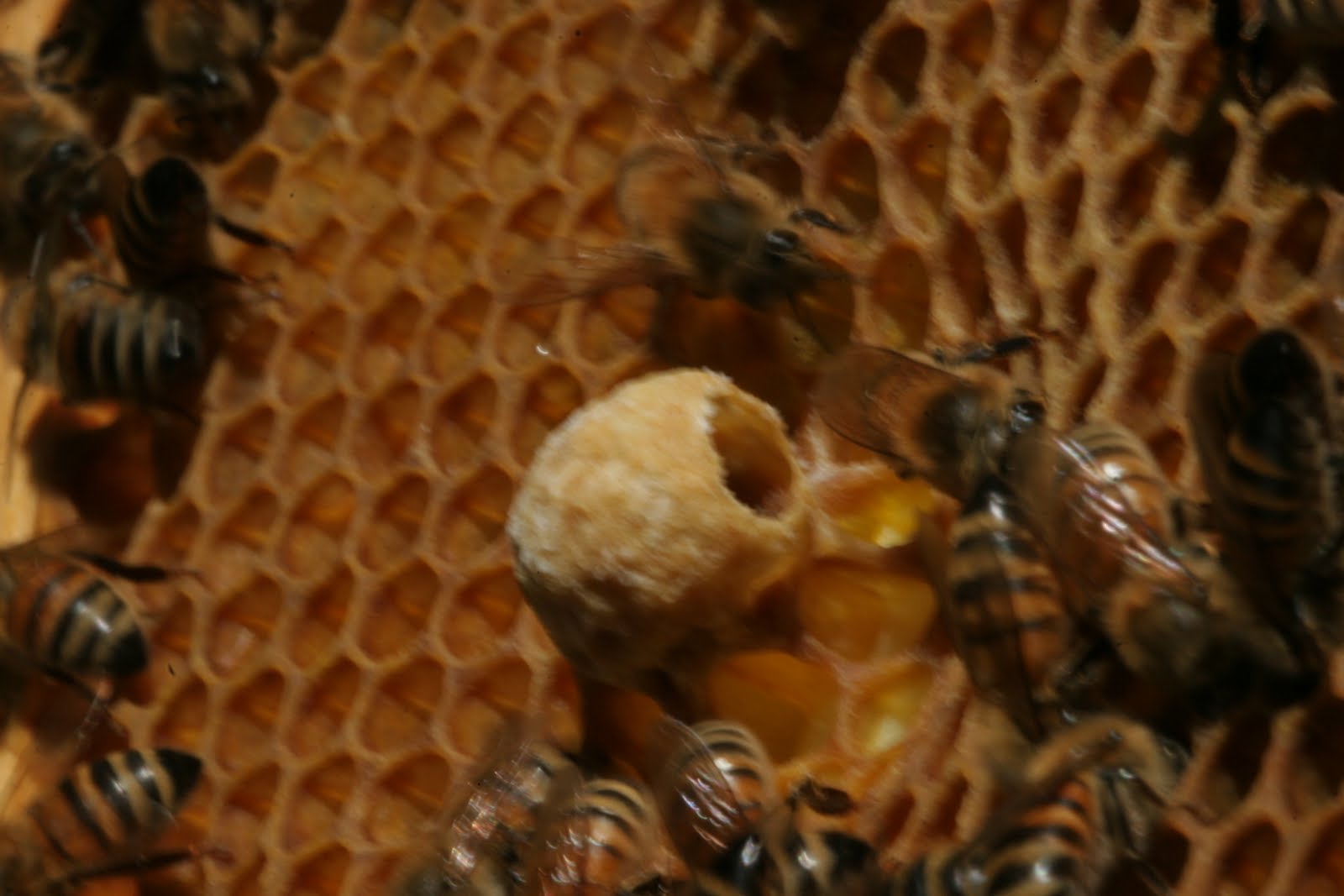
The Big Hive that we split a few months ago looks like it either is making a new queen for itself or is getting ready to swarm or both. (Or already did....possible origin of Small Swarm.) We found this perfect queen cell in the middle of the frame with some bees tending to it. Or tearing it down. It is so hard sometimes to tell what phase the bees are in. We tried to look inside but could not see if there was a queen larvae in there or not.
On the bottom of the frames we also found many many swarm cells. Again, it was hard to tell if they were being built or had already hatched.
The Split we made from the Big Hive somehow has foulbrood. It was doing so well I am not sure how this happened. We put them in new and clean boxes with brand new frames. I suppose some could have come over with the frames we split of from the Big Hive but it does not have foulbrood. So question mark, question mark. This disease is very irritating. I am not sure how to fully eradicate it from our apiary.
I have the antibiotics so we gave the Split its first dose today and will do the second one as recommended.
Lots of pollen of all different colors and textures. Four of the hives are doing well. Hopefully the Split will bounce back. Now that the weather has cleared up a bit they will be flying and building up their field forces for collecting nectar and pollen.
The Big Hive that we split a few months ago looks like it either is making a new queen for itself or is getting ready to swarm or both. (Or already did....possible origin of Small Swarm.) We found this perfect queen cell in the middle of the frame with some bees tending to it. Or tearing it down. It is so hard sometimes to tell what phase the bees are in. We tried to look inside but could not see if there was a queen larvae in there or not.
On the bottom of the frames we also found many many swarm cells. Again, it was hard to tell if they were being built or had already hatched.
The Split we made from the Big Hive somehow has foulbrood. It was doing so well I am not sure how this happened. We put them in new and clean boxes with brand new frames. I suppose some could have come over with the frames we split of from the Big Hive but it does not have foulbrood. So question mark, question mark. This disease is very irritating. I am not sure how to fully eradicate it from our apiary.
I have the antibiotics so we gave the Split its first dose today and will do the second one as recommended.
May 6, 2011
sealing off the entrance
The swarm we caught on 30th and Church, The School Yard Swarm, is building this waxy barrier at the entrance to their hive. It is sunny and hot so I am not sure what they are up to. But they know best, so we'll leave them alone for now.
March 20, 2010
surprise in the second hive
pollen
My heart lurched. I could have squashed or injured the queen with my carelessness. The chance of her being on that frame was so small I did not even consider it a risk. But from now on I will assume she could be anywhere in the hive and to act like she might be on any frame I pull out.
I got some good pictures of her wandering around while Peter S. held the frame in the sunlight for me. She is dead center in the picture below. Notice how she is elongated and the color of polished wood rather than golden and striped like the worker bees.
The Queen!
We set her aside in an empty hive box out of the way from harm and continued our inspection. In particular, I wanted to see those supercedure cells in case they had hatched. The brood pattern was healthy. There were a few drones (male bees) wandering around but I did not get a picture of them.
About halfway through the hive we spotted the queen cells and had Peter S. look at them to tell us if they were new or already hatched. He could not tell but had us look inside to note that there was no egg or larvae at the bottom surrounded by royal jelly so most likely they were old. A beekeeper can predict the behavior of the hive by noting where the queen cells are located. If they are hanging off the bottom of the frame they are swarm cells and the hive is preparing to fly the coop, taking your workforce and honey producers along with it. The beekeeper can scrape those swarm cells off in an attempt to discourage the bees from swarming.
If the cells are more in the center of the frame like these are, the hive is making a new queen for itself to succeed the current queen who may be laying poorly, injured or dead. It is best to leave those cells alone. Or, if you see plenty of eggs and larvae and a laying queen you can take that frame out of the colony and place it in a new empty box along with some frames of brood and nurse bees to make a brand new colony. That is what we were hoping to do with this colony but since the queen cells were not in use we decided to just leave the hive alone.
Queen supercedure cells
We had the entire colony cracked open and spread out all over the bee yard. Each of us had a frame of bees in our hands. I was sorting through some boxes to find extra deep frames when Peter S. again yelled out that we had a problem. He gathered us around and showed us a cracked brood cell and that is when I smelled it. Foulbrood. It smells rotten, like really old dirty laundry, or rotting bugs and fermented honey. I thought I had smelled it earlier when we were sorting through some of the frames filled with honey but I just thought it was something on my gloves or some other funk. I should have spoken up.
Then all hell broke loose. We had stuff strewn all over the yard and now we realized that we had no way of knowing for sure if it came out of the sick hive or was leftover from working with the healthy hive. The reason we needed to know is that all frames in the sick hive had to be destroyed and all the boxes needed to be scorched. We had just made a lot of work for ourselves.
There was a bit of a kerfuffle while we threw out ideas for how to fix this problem. In the end we decided to shake all the bees into a new empty box of frames with new wax foundation and have them start over from scratch. We put down one deep with empty frames and one super with drawn comb so the queen would have somewhere to begin laying as soon as the workers cleaned out the comb.
The first shake rained a shower of contaminated nectar into the new boxes. So then we had to shake out the nectar onto the ground and then the bees into the hive. It was heartbreaking to see all the beautiful comb and brood and nectar go into the big black trash bags. All that work just thrown away. I ran in the house to get the antibiotic, Terramyacin, and mixed it with powdered sugar to treat the hive.
powdered antibiotic on the ends of each frame
After everything was put back together Charley collected all the hive tools so he could sanitize them. I went back and boiled up some 1:1 sugar syrup, waited for it to cool and poured it into a ziplock bag. I put one ziplock bag into each hive and poked holes in it so they could get to the sugar water. Feeding them this sugar water will give them the energy to build out all the new comb they will need to build up their population again.
March 19, 2010
Splitting the Superstar Hive
Peter H. and Charley wait for Peter S. to get done with his phone call.
Tuesday we headed out to the beeyard to split the big superstar colony, hopefully preventing it from swarming this spring. The idea is that the beekeeper interrupts the bees' process of preparing for a swarm by dividing it in half and refocusing the bees on to building comb and building up their population. When a colony swarms, a totally natural springtime event that propagates the bee species, the end result is two colonies. A swarm is a beautiful sight to behold. It sounds like a freight train steaming through your yard and to see 20,000 golden buzzing insects in flight is breathtaking. The problem with swarming for the beekeeper is that you might not be there to catch the swarm and place it in a new hive box, plus the colony that stays behind will not produce much honey that year. For urban beekeepers, the bigger problem is freaking out your neighbors when 20,000 bees move into their attic or garage en masse. Managing the colonies to prevent swarming is the most responsible thing to do in an urban setting, it is beneficial to the beekeeper because you keep both colonies in your beeyard and perhaps beneficial to the bees...since they have expanded to two colonies without the effort of building up a swarm and do not have to look around for a new home.
My beekeeper friend, Peter S., came over to lend his experience and my co-beekeepers, Peter H. and Charley were also on hand for the excitement and to lend their brute strength (full hive boxes are heavy). I planned on standing back and taking lots of photos.
We started by opening up the hive and having a look at what they were up to on this fine spring morning. The hive was bubbling over with bees and they contentedly worked away as we lifted frame after frame and inspected them for a healthy brood pattern, the queen and any possible problems.
Peter H. and Charley look for the queen.
Peter H. hoping for his first glimpse of an egg.
We looked and looked but could not locate the queen. She was in there, because we saw many freshly laid eggs. This queen has a very healthy laying pattern. We saw a lot of capped and uncapped brood. I was able to see some eggs and larvae in various stages of development.
frame of uncapped larvae and eggs. The queen is probably on this frame or one nearby.
uncapped larvae
freshly laid eggs and a larger larvae
Since this hive was so healthy and active we decided it was a good candidate for a split. It was a little annoying that we could not find the queen and set her aside during the split, but even if we could not find her we knew she would end up in one or the other boxes. It is just better to keep her out of the way so nothing bad happens to her while moving all the frames and boxes around.
I had set up an empty hive box at the end of the beeyard a few days before just in case they swarmed and happened to find the box inviting. We took a frame with eggs and uncapped larvae and moved it into the middle of the empty box. Then we found another frame of mostly capped larvae and nurse bees and moved that one into the new box next. One either end of the box we placed a full frame of capped honey. Then just in from that a frame of pollen. I scrounged up 4 frames of empty drawn comb and we filled up the rest of the ten frame box with those so the queen would have someplace to lay her eggs.
The bees were getting a little irritable so we quickly closed the new hive up and went back to what was left of the original hive and filled in the empty spaces with new frames of wax foundation so they could get going on drawing out new comb. I had set a deep box on the hive the week before to give them space and maybe keep them from swarming until we could get out there and give them a proper inspection. That was not really a smart move because now the bees were putting capped honey in the deep frames which means we would have to extract a really heavy box of honey later on. But it was already started so we found some other half filled frames of honey and stuck them in the deep with a queen excluder separating the brood nest from the honey, hoping that they would fill those frames up in the next week or so and then we could extract them and use them in the brood chamber once they were empty of honey.
The split of the superstar hive went very smoothly. The two new hives seemed to be set up pretty well for spring. One of them contains an already laying queen and the other enough eggs and nurse bees so that they can create a new queen by feeding a few of the eggs royal jelly. Hopefully, if we keep up on them and give them all the space the queens need to lay eggs, we may have acted early enough to prevent any swarms this season. Of course, the bees do what they want, so they may decide to swarm later anyway.
March 8, 2010
Cleaning Moldy Frames
Today I grabbed all the moldy fuzzy frames and hosed them out. Underneath the mold were beautiful swirls of pollen. Another beekeeper told me that as long as the bees are not overwhelmed by the mold they can usually handle cleaning it out themselves. He said they even have been know to eat the mold and blend it into their bee bread. These frames were pretty fuzzy, so I figured I would give them the upper hand and hose some of it out for them.
I knew it was going to rain the next day so I stacked all the frames up on my sweet pea tower to hopefully dry out before the rain. The bees found them right away and started cleaning out the cells and carrying back the good stuff they could salvage back to their hives.
February 20, 2010
Inching the Bees
I found some wooden platforms at the green dump this week that are perfect for moving beehives slowly across the garden into the sun. The hives are heavy so I cannot move them alone unless I dismantle them and move the hive box by box. I don't want to disrupt the bees that much every day.
The platforms are a perfect solution. I love to save stuff from the dump, so that was a bonus as well. I needed help initially in getting the stack onto the platform, but now that they are up there I can just slowly slide them over a foot per day on the platform without having to get someone to help me. Much easier than trying to suit two people up every single day just to go out for 5 minutes to lift them. It does not jostle or disturb the bees. They hardly even noticed when I went out there today. Easier on the back, too.
The brick colored hive is the superstar hive. I think it will produce a lot of honey this year. The green hive is also strong. The short blue hive box in the foreground is empty right now. I am either going to buy a nuc from a friend who is raising bees of a few different races or wait for one of ours to swarm. I might even try to do a split later in the season.
A split is when you take a healthy hive with a good population and remove a few frames that have eggs 3 days old or less, uncapped and capped larvae along with the nurse bees and put it in its own small nuc box. The bees realizing they do not have a queen, will start feeding the eggs royal jelly and make themselves a new queen. You have just made it possible for one hive to become two.
You can also prevent swarms by doing splits so the bees do not feel crowded. Since bees naturally swarm in spring to propagate their species, the beekeeper can take advantage of this natural tendency to make more colonies out of a single productive colony. If you see a queen cell on a frame you can remove that frame as part of the split because you will have a head start on a new queen.

The brick red hive started out on the cinder blocks in the lower left corner of the photo. Over the past week I have moved the hive a foot per day so now it is about 7 feet away from its original shady location. I noticed some of the bees were confusedly circling around the old locations so I decided to put off the next move for a few more days till everyone in the hive understands where their house is. If you look closely, you can see bees sitting on the cinder blocks, on the side of the hive and on the stacks of empty boxes behind their hive. There are quite a few in the air, as well, but I could not get a good photo of them.
It has been too overcast to do the powdered sugar Varroa mite treatment. It is supposed to rain all this weekend and next week, but maybe there will be a sunny day were I can slip the sticky board under the screened bottom board and sprinkle the powdered sugar in the hives. It makes the bees groom each other, the mites fall off and can't get a footing in the slippery powdered sugar and they end up stuck in the margarine on the board below. What a way to go.
February 11, 2010
February Inspection Part Two
The South Hive is our new superstar. It is a swarm out of the original hive that moved into my wall and started this whole apiary. There was a bit of scare this winter when it got foulbrood, but it succeeded, with the help of some antibiotics, to overcome the disease.
Right now it is composed of two deeps and one super, all for brood. I checked the entrance and the bees seemed calm. I lost my calm when I opened up the lid and found this lurking on the inner board. It is about the size of a quarter.
As if having a big ugly red parasite on you as a baby bee maggot is not insulting enough, when the bees hatch their wings are deformed and they are weaker than their healthy sisters. I saw a few bees that had been damaged by the mite and got a pretty good photo of one.
Right now it is composed of two deeps and one super, all for brood. I checked the entrance and the bees seemed calm. I lost my calm when I opened up the lid and found this lurking on the inner board. It is about the size of a quarter.
The hive is bursting out of the top board. A good sign.
The top super contained a lot of capped and uncapped honey, some spotty drone and worker brood and pollen. When I pulled out one of the frames I saw it was connected to the middle box by a few rows of drone larvae. They were torn open in the process, so I was able to photograph what the bee larva looks like. Once I got the camera in there I could see that the drone larvae had some of the Varroa mites attached to them. They are big and red and look like a flat tick. They are more attracted to drone brood for some reason, so one of the ways you can clear them out of your hive is to throw out all the frames that have drone brood. there is a special frame designed just for that method. I bought one last year and maybe I will end up using it.
You can see the mites in this photo in the upper right corner of the photo.
It is the red disk on the white body. Here is a closer look.
As if having a big ugly red parasite on you as a baby bee maggot is not insulting enough, when the bees hatch their wings are deformed and they are weaker than their healthy sisters. I saw a few bees that had been damaged by the mite and got a pretty good photo of one.
Here is an adult worker bee that has one.
It does not have the damaged wings, so it must have gotten this parasite after it hatched.
The middle deep had a beautiful brood pattern, pollen, honey. The works. The bottom deep was completely empty of bees. There were the four frames of capped honey I had put in there at the beginning of winter and the rest were empty drawn comb. The queen had moved her operation upstairs, as they tend to do. Time to do a little swapping of boxes. I put the middle and upper boxes full of brood and bees on the bottom and moved the empty deep to the top of the hive so the queen could keep moving upwards and building up her colony for spring. I also took their entrance reducer off since they seemed to have plenty of guard bees.
By this time the weather had turned cold and windy and the bees were pretty irritable. they were loudly buzzing and pelting me with their little bodies. I could smell the familiar banana scented alarm phermone and figured now would be a great time to close them back up. Below you can see in the lower left corner, the bees are having a little conference about how they are going to try to get that big white suited guy the heck away from the nest.
Next up: applying powdered sugar to the bees and catching the falling mites on a stickyboard.
February 10, 2010
February Inspection Part One
The weather has cleared up a bit after all the rain so I thought it would be a good time to see what the bees were up to. I only have 2 colonies right now and I do not want them to swarm. Best to see if they need anything now before it is too late.
The first thing I did was clean up the dead hive and burn out the bottom board and boxes. There was a lot of capped honey in there I had given them a few months ago in hopes they would use it during the winter. I had treated them with antibiotics a few times to try to stop the foulbrood, but they did not make it. I know this honey was capped before I put the powdered antibiotics in the box so I set it aside to be extracted. I could see they had lost their queen by the queen cells they had built. They tried so hard to make it, poor things.
Peter and I have been talking about moving the bees up onto the roof or onto his mother's deck, but I don't think that will happen this year. Instead, I will start moving them bit by bit over to the sunnier back fence. I really think it will help them to be in more sun. They can start their day earlier and the hive does not have to work so hard to stay warm and dry in our damp foggy climate. If you move them one foot per day they will acclimate to the new location of the hive. Any further than that and they will lose their bearings. So today was the day to start the first foot out of about 15.
The storage stack of boxes and frames is against the sunny fence right where we want to put the bees, so I lay down a big piece of plywood where I thought the stacks would be out of the way and got ready to move them. There are wood chips in the garden that get stuck on the bottom of the boxes and that annoys me when I am in a hurry to close the boxes up. I find the plywood platform to be helpful. I sorted through each box and looked at all the frames to refresh my memory for what I have to work with and to make sure that nothing has been damaged by moths or mice or other critters over the winter. Some frames had been put into the storage area with uncapped honey or nectar and they were absolutely consumed with the most spectacular array of colorful molds I have ever seen.
I set those four aside to clean out later. I probably could hose out the worst of it and let the bees do the rest. I put together a few boxes of frames with nicely drawn out comb, a few others with capped honey. I found the one annoying plastic frame I keep meaning to get rid of and threw it in the trash pile. Good riddance. I also found some warped frames and got rid of them too. They cause such a problem when inspecting the hives. They don't line up in the hive box right and the bees build burr comb in the extra space so when I try to pull the frame out to have a look it tears capped honey and brood and pisses the bees off.
I picked a few good spots on the back fence as a final destination for the hives, set up a new empty hive box in hopes we catch a swarm this year, then set out some cinder blocks one foot away from each hive so I could move them easily as I inspected. With the empty hive boxes all organized and moved to their new storage spot and the rest of the plywood platforms and boxes full of capped honey and comb arrayed around me, I was ready to open up the hives.
I got the smoker going and slowly waved my hand in front of the entrance to check the mood of the North hive. None of the guard bees followed my hand and none flew out at me. They were calm and busy. Some of them were carrying a lot of yellow pollen. This hive is less active and for winter is made up of one super on top and one deep on the bottom. I opened the top, remembering not to smoke the entrance since it drives them up into the hive. If I am going to smoke them, I should wait till the box is open and smoke them down from the top.
They looked good, busy and calm. They had two empty frames of drawn comb on one side and three on the opposite. In between were five frames of nice looking pattern of capped brood, larvae, and I assume eggs. I have not gotten good at seeing them yet. I think the queen was in this section because they really started buzzing, but I did not see her.
This image just amazes me. Bees made this! It is so beautiful and perfect. The texture is gorgeous.
The larger raised bullet shaped capped brood is drone brood. This colony is gearing up fro spring and queen mating. You can see a bee cleaning out a cell, probably its own. That is the first thing they do when they hatch.
Here is a brand new bee chewing its way out of it's cell.
I lifted the top super off and placed it gently onto the waiting plywood platform and covered it with a board so the bees would not get cold and so the queen would not accidentally fly out.
I inspected the lower box and saw two frames of capped honey on one side and 3 frames of empty drawn comb opposite. In between were 6 frames of capped brood, no larvae and probably no eggs. The pattern was a little spottier than the upper box. I noted a few swarm cells were being built or maybe were left from last year. I did not see anything in them.
This hive looked great so closed it up and moved it onto the new cinder blocks a foot away.
To be continued.....
Subscribe to:
Posts (Atom)