July 8, 2011
Bees Avoid a Big Boulder
The Daily Press,
May 14, 1910, Sheboygan, Wisconsin
Bees Avoid A Big Boulder
Move Out of Tree Before Huge Stone Crashes Into it Smashing Everything in Path.
New York.—Someone tipped off to a big hive of bees in a hollow tree at the foot of Hog mountain that a ten ton boulder was going to roll down from the top of the mountain and smash everything in its path, including the tree in which they had stored 700 pounds of honey. In what way they got the tip is not known.
The best evidence the bees had it is they moved to another tree out of the danger line a few hours before the big boulder made its sensational downward rush, and that Reuben Van Winkle, who owns the farm on which the bee trees are, returned from Montclair loaded down with presents he bought after he had sold the 700 pounds of honey for fancy prices. Incidentally, when in Montclair, he fell
so rich as a result of the bee tip and the boulder he went to the Central hotel and had a full course dinner.
The bees occupied the hollow tree ten years. Van Winkle never disturbed them, because he knew the
only way to get the honey was to cut the tree down. He was averse to doing that. So the insects worked
away until the tree literally was saturated with honey. Two weeks ago he noticed the bees were moving to another hollow tree. He thought it was because a new swarm was being driven out of the old quarters to find a new home. As he sized it up, nothing short of a big fight in the hive could force bees to go out in December.
Friday night the Van Winkles were aroused by a terrific crashing on the mountainside. Van Winkle got out of bed and went to investigate. By that time the noise had ceased and he could not discover the cause. In the morning, however, he saw the big boulder in his meadow and up the mountainside trees which had been felled by its rush. At the end of the line lay the old bee tree.
Then it dawned upon Van Winkle why the bees had moved.
thanks to Historical Honeybee


June 25, 2011
June 20, 2011
red and black queen


Our Big Hive looked like it was doing great so we did not open up the brood boxes. They tend to be aggressive so we figured no need to bother them if they were doing OK. Their honey supers were close to being finished but not quite ready. We moved some of the capped and partially capped frames of honey from the smaller weaker hives into the Big Hive's supers so the Big Hive could finish them up quickly and we could harvest them maybe next week.
Here's to the first (and late) harvest of 2011.
May 17, 2011
Wyoming Bees

I have been taking a painting class and decided to do something with the photos I took on a month long road trip across the country. This is a painting from a photo of commercial beehives in Wyoming.
May 9, 2011


May 7, 2011
May Inspection
We took advantage of a nice sunny day to have a look at the new colonies and do a hive inspection in the apiary. The Small Swarm and the School Yard Bees seem to be doing well. Lot's of activity.


The Big Hive that we split a few months ago looks like it either is making a new queen for itself or is getting ready to swarm or both. (Or already did....possible origin of Small Swarm.) We found this perfect queen cell in the middle of the frame with some bees tending to it. Or tearing it down. It is so hard sometimes to tell what phase the bees are in. We tried to look inside but could not see if there was a queen larvae in there or not.


On the bottom of the frames we also found many many swarm cells. Again, it was hard to tell if they were being built or had already hatched.
 The Split we made from the Big Hive somehow has foulbrood. It was doing so well I am not sure how this happened. We put them in new and clean boxes with brand new frames. I suppose some could have come over with the frames we split of from the Big Hive but it does not have foulbrood. So question mark, question mark. This disease is very irritating. I am not sure how to fully eradicate it from our apiary.
I have the antibiotics so we gave the Split its first dose today and will do the second one as recommended.
 Lots of pollen of all different colors and textures. Four of the hives are doing well. Hopefully the Split will bounce back. Now that the weather has cleared up a bit they will be flying and building up their field forces for collecting nectar and pollen.


The Big Hive that we split a few months ago looks like it either is making a new queen for itself or is getting ready to swarm or both. (Or already did....possible origin of Small Swarm.) We found this perfect queen cell in the middle of the frame with some bees tending to it. Or tearing it down. It is so hard sometimes to tell what phase the bees are in. We tried to look inside but could not see if there was a queen larvae in there or not.

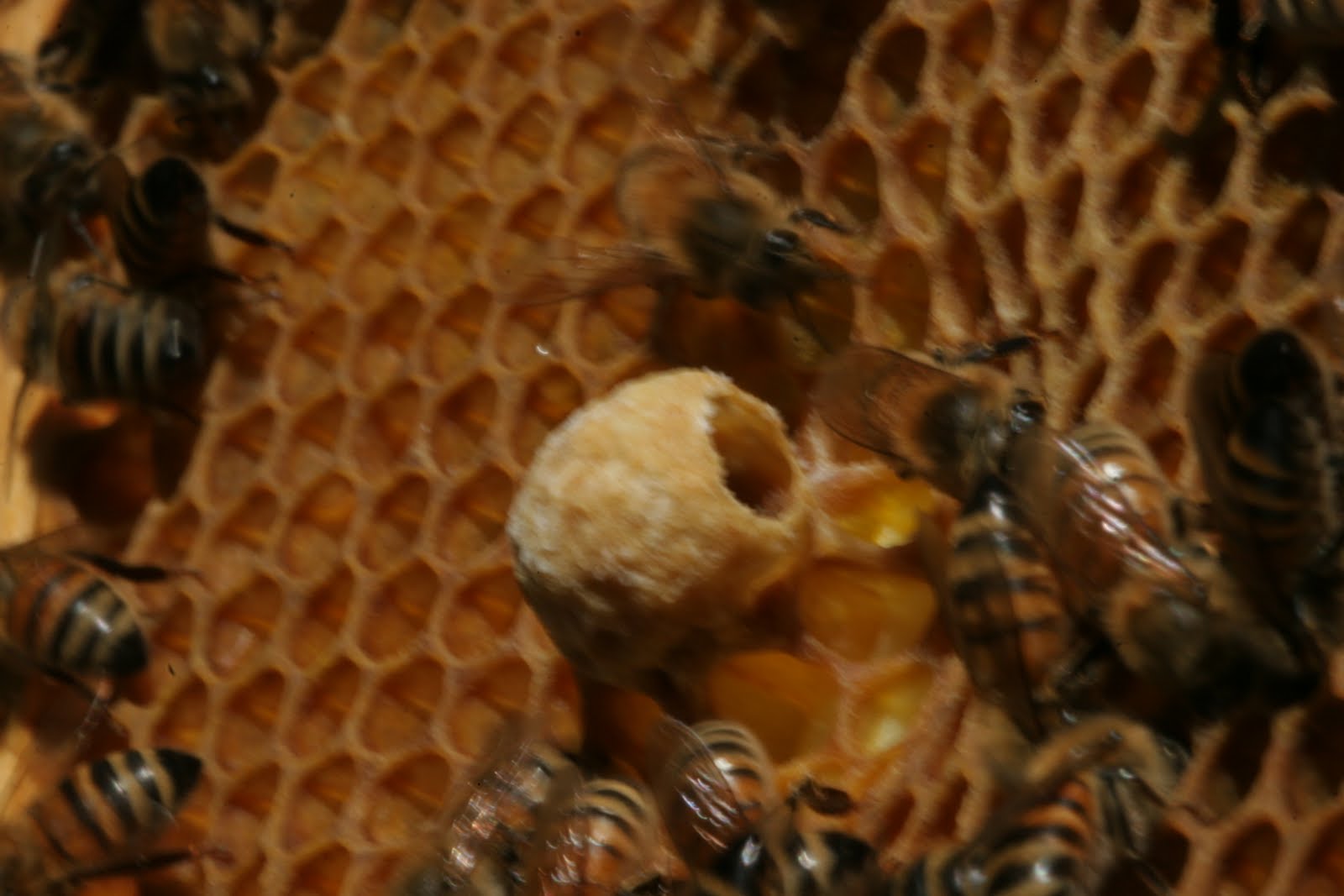

On the bottom of the frames we also found many many swarm cells. Again, it was hard to tell if they were being built or had already hatched.

I have the antibiotics so we gave the Split its first dose today and will do the second one as recommended.


May 6, 2011
sealing off the entrance
The swarm we caught on 30th and Church, The School Yard Swarm, is building this waxy barrier at the entrance to their hive. It is sunny and hot so I am not sure what they are up to. But they know best, so we'll leave them alone for now.


Subscribe to:
Posts (Atom)